DCWP - Complaint Pathways
Making Space When Seconds Matter
Industry
Government & Public Services
Scope of work
Usability Reaserch, UX Solutions
Duration
3 Month

We all like to complain. We made it easier for you
Project Goals

Assess if the complaint submission process would benefit from merging consumer and workplace complaints into a single location in the Business Portal.
Gather user feedback to identify pain points, usability challenges, and opportunities for improvement.
Let me tell you something about complaining
Optimizing Complaint Pathways is a project that examines how small usability gaps can create outsized friction in complex digital systems. Through moderated user testing, our team uncovered significant challenges around discoverability and decision making in the New York Departmnet of Consumer and Worker Protection (DCWP) online complaint process. Users frequently hesitated, second-guessed their choices, or missed key information altogether.
Guided by these insights, the project proposes a set of research backed design improvements focused on simplifying navigation, reducing cognitive load, and aligning familiar design patterns across pages. The team grounded the proposed solutions, to allign all users’ flows, by utilizing existing design elements present in other part of the website. This case study shows how homogenazing designs can make complex processes feel surprisingly simple.
The Challenge:
Simplifying a Complex Complaint System
The DCWP expressed to simplify how users on their website reach the Business Portal (complaint process entry point), so that “users can simply file a complaint, with the system automatically determining the type based on their responses”. While definitely an exciting prospect for the designers in our group, the challenge of merging the consumer’s and worker’s complaint forms would have required a full overhaul of the whole DCWP website.
In order to avoid a time consuming and costly process the team set out to understand the issues in the complaint process in it’s current state (as of November 2025). To gain this insight a moderated user testing method was employed, and eight participants were selected to test the usability of the website.
The moderated usability testing research method was employed to ensure ecological validity: study findings are generalizable, as conducting the study remotely replicates settings typical of everyday life, with participants using their own devices to complete the tasks. This method is considered the gold standard for usability testing due to its high level of observational depth, allowing researchers to probe user behavior in real time and capture both actions and underlying reasoning as participants navigate the experience.

Testing the DCWP Complaint Experience with Real Users
The team conducted a moderated usability test with eight participants living in New York City. alf of the participants were assigned to the Consumer Complaint Scenario condition, while the other half were assigned to the Workplace Complaint Scenario condition. While eight participants is a solid starting point for this type of user testing, the team would have taken a more aggressive recruitment approach given the high number of non-responses. Nevertheless the testing outcomesm gave the team strong data to base our recommendations on.


What the Moderated User Testing Revealed
Based on the tests conducted the team uncovered several usability issues. Most importantly, the results indicate that the pretense posed by the DCWP of merging complaint forms to simplify the process might not be the best solution. 100% of participants — without being informed of which condition they were assigned — successfully identified their scenario as either a consumer or workplace issue. Moreover, the test yielded 25 qualitative findings that the team used to based the following recommendations on. While users in the consumer complaint process experienced only minor usability issues, those in the worker condition struggled considerably at several points in the complaint process.
Key Usability Issues in the
Worker Complaint Journey
The Issue
1- Within the “Worker Rights” webpage, workers often struggled to navigate through to the “File Complaint” subpage
2- Within that “File Complaint” subpage, workers are largely confused by the list of laws displayed within the “File Complaint Online” section
3- Workers experience difficulty finding information regarding the workplace complaint process and possible outcomes; they do not feel assured that their workplace issues would be remedied by the NYC DCWP
Recommendations to Improve the Experience
1- Improve discoverability of the workplace complaint form through integration into secondary navigation menu and inline link
2- Mitigate confusion surrounding workplace complaint business violation selection by creating a single Business Portal that lists and describes each workplace law
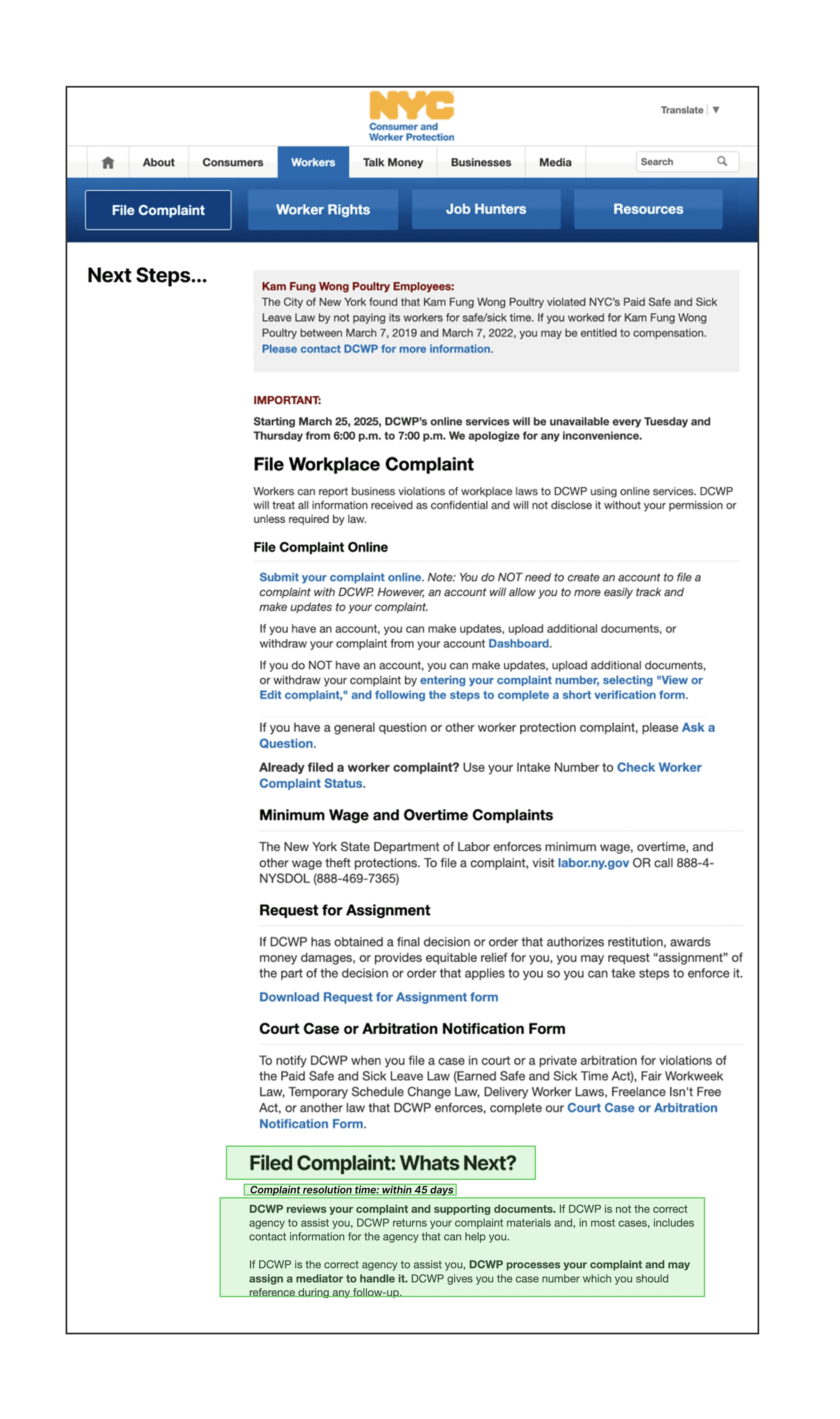
3- Support worker comprehension of complaint process and outcomes through supplemental “Filed Complaint: What’s Next?” section.
We carefully designed these reccomnadations to be seamlessly integrated in the current website. While each design is individually effective, all together would collectively enhance user experiences with the NYC DCWP website and complaint submission processes.
Key Usability Issues in the
Worker Complaint Journey
Improving discoverability of the Workplace Complaint Form through addition of a secondary navigation link and a single inline text link


Merging all workers’ forms into one simple, easy-to-access “Workers’ Complaint Form.”


Improving visibility of Next Steps post complaint submission


Now Complaining is easier
As a team, we listened carefully to the team at the DCWP, andn we clearly understood that there was a significant issue with the design of their website. However, instead of acting quickly to fix their proposed issue, we took a steop back, designed a user test to gether data and through that data outlined recommendations that can better enhance the user experience on the DCWP website.
The recommendations focus on the discoverability of the workplace complaint submission portal to ensure that users can actually find the starting point they need. Merge all worker complaint forms into one unified, easy-to-access portal t0 reduce confusion and create a consistent, predictable experience aligned with the existing design of the consumer complaint portal. Elevate the visibility of the complaint submission process and outcomes to help users feel informed, reassured, and confident that their complaint will be remedied effectively. We encourage the NYC DCWP to take these user experience recommendations into consideration when revisiting the design of the website to better support New Yorkers in voicing their concerns.
Project Impact and Stakeholder Response
Upon presenting the project, the members of the DCWP were ecstatic. They expressed their support for the path we took with the project, and were very interested in the valuable qualitative and quantitative data we gethered. Going forward we made ourselves available for any inquires about our project results as the DCWP focuses on implementing our tem’s suggestion to the future iterations of their website.